
Arch Support Insoles: The 2026 Guide to Foot Alignment and Pain Relief
You swing your feet out of bed, expecting a fresh start, only to be met with a sharp, stabbing sensation in your heel the moment you touch the floor. It’s an exhausting way to begin the day. For many, this morning agony is followed by a heavy, aching fatigue that sets in after just a few hours of standing at work. You’ve likely tried soft, pillowy inserts before, only to find the relief is temporary and the confusion over your actual foot type remains. High-quality arch support insoles are about more than just cushioning; they’re about restoring the natural alignment of your body.
We understand that chronic foot pain impacts your quality of life. Approximately 1 in 10 adults will develop plantar fasciitis, yet most people struggle to find a solution that actually works. This guide will show you how medical-grade arch support insoles correct biomechanical imbalances to provide lasting relief from chronic pain. We’ll help you identify whether you have flat feet or high arches, explain the importance of professional-grade engineering, and provide a clear path to pain-free walking and standing.
Key Takeaways
- Discover how stabilizing the 26 bones and 33 joints in your feet can prevent pain from radiating up through your knees and lower back.
- Learn why medical-grade arch support insoles made from high-density EVA provide superior durability compared to generic foam alternatives.
- Master a simple at-home test to determine your specific arch height and ensure you choose the correct level of correction.
- Identify the right orthotic volume for your daily lifestyle, ensuring a perfect fit in everything from athletic trainers to professional work boots.
- Explore the podiatrist-developed engineering behind Footlogics that has helped millions move comfortably and pain-free.
What Are Arch Support Insoles and How Do They Work?
Arch support insoles are biomechanical stabilizers that prevent excessive foot rolling. They are precision-engineered tools designed to support the plantar fascia and maintain the correct anatomical alignment of the foot. Unlike basic cushions, these devices address the root cause of discomfort by controlling the way your foot interacts with the ground. By providing a firm foundation, they redistribute weight and pressure away from sensitive areas like the heel and the ball of the foot.
Many shoppers confuse a standard shoe insert with a structured orthotic. A typical retail insert is often made of soft, unsupportive memory foam or gel. These might feel comfortable for a few minutes, but they quickly flatten under your body weight. In contrast, medical-grade arch support insoles use durable materials like high-density EVA to provide a consistent lift. This structural integrity is what allows the insole to correct your gait rather than just padding it.
The primary goal is to achieve a neutral foot position. When your arch collapses, your foot rolls inward, a process known as over-pronation. This movement creates a twist that travels up your leg, affecting your knees and hips. A well-designed insole stops this collapse, ensuring your body weight is evenly distributed. This relief is vital for anyone suffering from chronic inflammation or structural strain.
The Three Primary Functions of an Orthotic Insole
A professional-grade insole performs three critical tasks to protect your mobility. First, it provides Support by maintaining the structural integrity of the medial longitudinal arch. This prevents the “fallen arch” sensation that causes so much fatigue. Second, it ensures Alignment. By keeping the foot in a neutral position, the ankle, knee, and hip remain in a straight, healthy plane. Finally, it offers Shock Absorption. High-quality orthotics reduce the impact force during the heel-strike phase, protecting your joints from the repetitive trauma of walking on hard surfaces.
Who Benefits Most from Arch Supports?
If you experience sharp, stabbing pain in the morning, you likely have Plantar Fasciitis. This condition thrives on a lack of support, making arch support insoles a non-negotiable part of your recovery. Individuals with flat feet or excessively high arches also benefit from the added stability, as these foot types are naturally prone to injury. Professionals who spend 8 or more hours standing on hard concrete, such as nurses, retail staff, and warehouse workers, find that these insoles significantly reduce daily fatigue and long-term joint wear.
The Science of Foot Biomechanics: Why Your Arch Matters
Your foot is a complex masterpiece of biological engineering. It contains 26 bones and 33 joints, all working in a synchronized rhythm to support your entire body weight. When these components are aligned, your movement is fluid and painless. However, even a minor deviation in your foot’s structure can disrupt the entire system. This is where arch support insoles become essential. They don’t just provide a soft surface; they act as a corrective foundation for a sophisticated mechanical structure.
Biomechanics isn’t just about the feet. It’s about the “Kinetic Chain.” Think of your body as a tall building. If the foundation is slightly tilted, the windows on the top floor won’t close properly. When your feet are misaligned, it forces your ankles to rotate, which then twists your tibia and puts unnecessary strain on your knees and lower back. Many people treat their back pain for years without realizing the problem actually starts at the ground level. Proper alignment at the base stops this destructive chain reaction before it reaches your spine.
Understanding the gait cycle helps explain why support is so vital. Every step involves three distinct phases: the heel strike, mid-stance, and toe-off. During mid-stance, your arch should remain stable to absorb your body’s weight. If the arch collapses here, the foot loses its ability to act as a rigid lever for the toe-off phase. Many people mistakenly reach for “soft” or “cushioned” inserts to fix this. Softness is often the enemy of good biomechanics. A marshmallow-soft insole collapses under pressure, providing zero structural correction. True relief comes from firm, medical-grade materials that hold the foot in its ideal position.
Overpronation vs. Supination
Overpronation is the most common issue, where the foot rolls excessively inward, typical of those with flat feet. This places immense strain on the internal ligaments. Supination, or underpronation, is the opposite; the foot rolls outward, which is common in high arches and leads to poor shock absorption. Specific arch support shapes are required to correct these opposing forces. Using a podiatrist-designed solution like Footlogics orthotics helps restore your foot to a neutral plane, regardless of your natural arch height.
Long-term Effects of Unsupported Arches
Ignoring foot misalignment leads to more than just daily aches. Over time, pressure imbalances cause the development of painful bunions and hammer toes as the small bones of the feet try to compensate for the lack of stability. You also face an increased risk of stress fractures in the metatarsals because the foot can’t distribute impact forces correctly. Perhaps most common is the chronic inflammation of the plantar fascia ligament, a condition that becomes increasingly difficult to treat the longer it’s left unsupported. Investing in quality arch support insoles is a proactive step toward preventing these permanent structural changes.
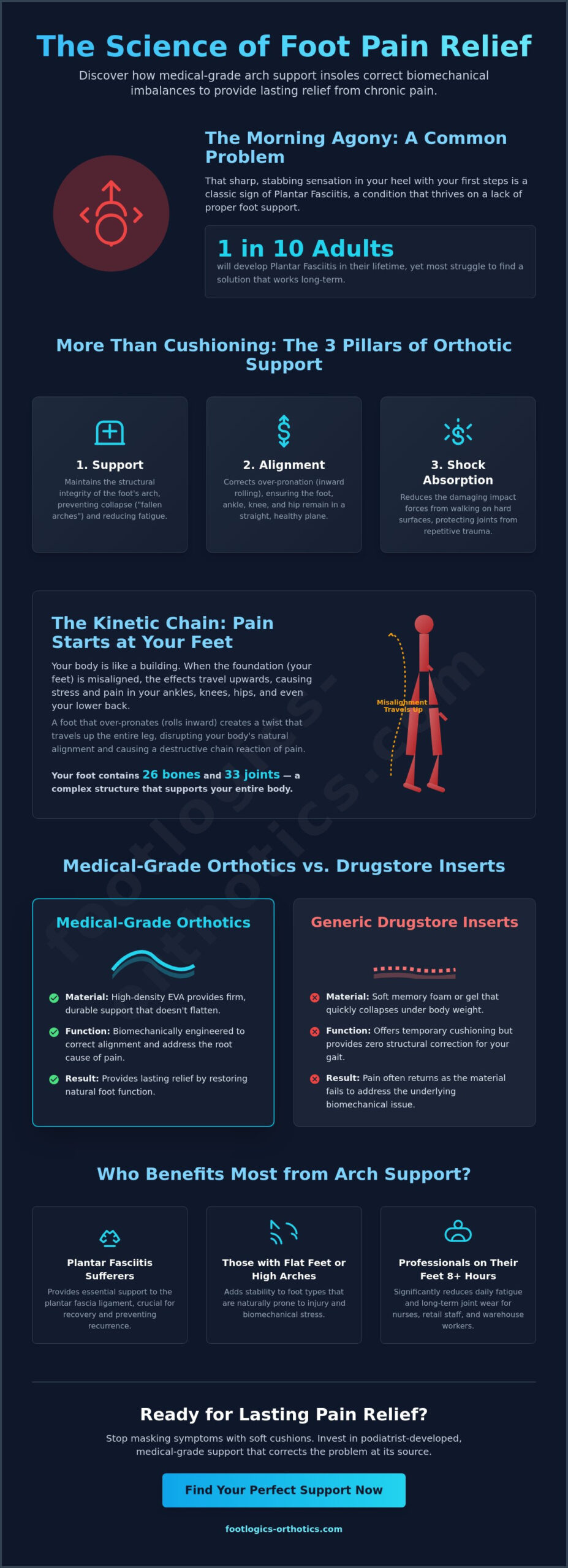
Medical-Grade Orthotics vs. Drugstore Shoe Inserts
Walk into any pharmacy and you’ll see rows of colorful gel and foam inserts. They look inviting. They feel squishy. But for someone dealing with real pain, these drugstore options are usually a letdown. True arch support insoles need structural integrity that simple retail foam lacks. While a drugstore insert offers immediate cushioning, a medical-grade orthotic provides long-term biomechanical correction. If you want to stop the pain, you have to stop the collapse of the arch.
The secret lies in the materials. Most mass-market inserts use low-density memory foam or soft gel. These materials cushion your foot but don’t support it. Under the pressure of a single step, they compress and leave your arch to collapse. Professional orthotics use high-density EVA (Ethylene Vinyl Acetate) and TPU (Thermoplastic Polyurethane). These materials are firm enough to hold your weight yet flexible enough for a natural gait. Medical-grade EVA maintains its structural support for up to a year, whereas standard retail foam typically collapses and loses its corrective shape within mere weeks.
The Cost-Benefit Analysis
Buying cheap inserts creates a cycle of constant replacement. You might save money today, but you’ll be back at the store in a month when the foam fails. This “subscription to discomfort” is both expensive and ineffective. At the other extreme, custom-molded prescription orthotics are a significant investment that requires professional consultations. Medical-grade, over-the-counter arch support insoles bridge this gap. They deliver professional-level biomechanical support without the wait or the custom-made price tag. You get the medical-adjacent solution you need without the unnecessary complexity.
Podiatrist-Designed vs. Mass-Produced
Design is where medical-grade options truly shine. Mass-produced inserts are often flat or have a generic, poorly placed arch bump. In contrast, podiatrist-developed orthotics are the result of intensive biomechanical engineering. They feature deep heel cups to stabilize the heel bone and prevent shifting. They also include contoured arch shapes that mirror human anatomy. Clinical testing ensures these features work together to manage pain effectively. Don’t settle for a generic product when your mobility is on the line. Seek out designs backed by clinical expertise and proven results.
How to Choose the Right Arch Support for Your Feet
Finding the right arch support insoles isn’t a guessing game. It’s a process of matching your foot’s unique geometry with your daily lifestyle. You don’t need a clinical lab to start this process. You can begin with a simple home assessment to understand your specific needs. This ensures you select a solution that corrects your alignment rather than just adding bulk to your shoes.
Start with the “Wet Foot Test.” Wet your sole and step firmly onto a piece of cardboard or a dark towel. If the print shows your entire foot shape, your arches have likely collapsed. A very thin line connecting the heel and the ball of the foot indicates a high arch. A middle-ground curve suggests a neutral arch. This test provides the essential data you need to choose the correct level of structural correction. Knowing your arch type is the first step toward lasting relief.
Next, pinpoint your primary pain point. Sharp, stabbing pain in the heel every morning usually signals plantar fasciitis. Burning or tingling in the ball of the foot often points to metatarsalgia. If you feel a generalized ache through the center of your foot after a long day, you likely need stronger medial arch stabilization. Identifying exactly where it hurts helps you choose between targeted metatarsal support or more general longitudinal arch lift.
Consider the volume of your footwear. Full-length insoles are designed to replace the existing liners in sneakers or work boots. They provide edge-to-edge support and extra cushioning for the toes. If you wear slim dress shoes or footwear with non-removable soles, a 3/4 length insert is the smarter choice. It provides the same podiatrist-grade biomechanical support without crowding your toes or making your shoes feel too tight.
Matching Insoles to Your Activity Level
Your movement patterns dictate the type of materials you need. For running and high-impact sports, you require high-rebound materials that return energy while absorbing heavy shock. If you stand for 8 or more hours on hard surfaces, prioritize structural stability. This prevents the “heavy leg” feeling that sets in halfway through a shift. Everyday wear requires a balance. You want enough correction to align your gait without feeling overly rigid during casual movement.
Using an Online Insole Finder
Technology now brings the expertise of a podiatry consultation into your home. Digital tools allow you to input your shoe type, activity level, and specific pain points to generate a precise recommendation. This removes the confusion often found in crowded retail aisles. When shopping online, always look for brands that offer a money-back guarantee. This ensures you can test the biomechanical fit in your own environment without any risk. Ready to find your perfect match? Use our online insole finder to get started today.
Footlogics: Medical-Grade Support Delivered to Your Door
Footlogics isn’t just another retail brand. With over 2 million pairs sold worldwide, we’ve established ourselves as a global leader in foot health. Our arch support insoles are the result of rigorous podiatrist-led research and biomechanical engineering. We focus on designs that actually change how your foot interacts with the ground. By using medical-grade materials, we offer the structural integrity needed for real, lasting relief. We ship globally, ensuring that professional-level support is accessible to everyone.
Our commitment to quality starts with the engineering phase. Every product is developed to address specific anatomical needs. We don’t believe in generic cushioning. Instead, we provide a firm foundation that aligns the kinetic chain. This approach has helped millions of people regain their mobility and live without chronic pain. Whether you’re an athlete or a retail worker, our solutions are built to withstand the rigors of daily life.
Our Most Popular Orthotic Solutions
- Plantar Fasciitis Orthotic Insoles: These are specifically designed for targeted heel pain relief. They stabilize the plantar fascia ligament to prevent the sharp morning pain discussed in previous sections.
- Sports & Running Insoles: These offer dynamic support for high-impact activities. They protect your joints from repetitive stress during intense movement.
- Work Orthotics: Stability is key for those on their feet all day. These insoles reduce fatigue by maintaining proper arch height throughout long shifts on hard surfaces.
Why Customers Trust Footlogics
Trust is built on results and reliability. We provide an affordable alternative to custom-molded prescription orthotics without sacrificing clinical efficacy. Our arch support insoles deliver professional results at a fraction of the cost. We back our products with free worldwide shipping and a 90-day money-back guarantee. This allows you to test the biomechanical benefits in your own shoes, on your own schedule, with zero risk.
Expert guidance is just a click away. Our online Insole Finder tool acts as a digital mentor. It uses your specific shoe type, activity level, and pain points to generate a precise recommendation. This ensures you get the right support the first time. You don’t have to navigate your recovery alone. We’re here to provide the tools and expertise you need for a pain-free life. Find your perfect arch support with our Insole Finder today.
Step Into a Pain-Free Life
Your journey to pain-free movement starts with a solid foundation. You’ve seen how the right arch support insoles do more than just cushion your steps; they realign your entire body. By choosing medical-grade materials over generic foam, you’re investing in long-term structural health. Proper alignment prevents pain from traveling up to your knees and back. Understanding your arch type and shoe volume ensures you get the exact support your body requires for daily comfort.
Footlogics brings clinical expertise directly to your door. We’ve used high-performance materials to help over 2 million people worldwide find relief. Our podiatrist-designed solutions are built for durability and precision. We want you to feel the difference for yourself. That’s why we offer a 90-day money-back guarantee on every pair. You have nothing to lose but the discomfort that’s been holding you back. Reclaim your active lifestyle. Walk, run, or stand with total confidence again.
Shop Podiatrist-Designed Arch Support Insoles
Frequently Asked Questions
How long does it take to get used to arch support insoles?
It typically takes 3 to 14 days to fully adjust to new arch support insoles. Start by wearing them for just one or two hours on the first day. Gradually increase your wear time by an hour each day until they feel completely natural. This break-in period allows your muscles and tendons to adapt to the corrected alignment. If you feel minor pressure, it’s a sign your body is repositioning into a healthier posture.
Can I move my orthotic insoles between different pairs of shoes?
Yes, you can move your insoles between shoes, provided the footwear has a similar shape and volume. For example, a full-length sports insole fits well in most sneakers and work boots. However, moving a high-volume insole into a slim dress shoe may cause cramping. For the best results and convenience, many users prefer having a dedicated pair for their primary work shoes and another for their athletic footwear to ensure consistent support.
Do arch support insoles help with lower back and knee pain?
Arch support insoles significantly reduce lower back and knee pain by correcting the kinetic chain. As discussed in the biomechanics section, misaligned feet force the knees to rotate and the pelvis to tilt. By stabilizing the foundation, these insoles stop the internal rotation of the leg bones. This alignment relieves mechanical stress on your joints and spine, providing relief for those who stand on hard surfaces for long periods.
How often should I replace my orthotic insoles?
You should replace medical-grade orthotic insoles every 6 to 12 months, depending on your activity level and weight. While the structural shell remains firm, the top cushioning layers eventually compress and lose their shock-absorbing properties. If you notice visible cracking, persistent odors, or a return of your original foot pain, it’s time for a new pair. Regular replacement ensures your biomechanical alignment remains consistent and effective for daily wear.
Should I choose a hard or soft arch support?
You should prioritize firm, structured support over soft cushioning for genuine biomechanical correction. While soft insoles feel comfortable initially, they collapse under your weight and fail to prevent the arch from falling. A firm shell made of high-density EVA provides the necessary resistance to keep your foot in a neutral position. The best designs balance this rigid support with a comfortable, shock-absorbing top cover to protect the skin and soft tissues.
Can arch support insoles fix flat feet permanently?
No, arch support insoles do not permanently change the bone structure of an adult foot, but they provide essential functional correction. Think of them like eyeglasses for your feet; they correct the issue while you’re wearing them. For children, early use can sometimes help the arch develop correctly. For adults, they manage symptoms and prevent further damage by holding the foot in its ideal anatomical position during daily movement.
What is the difference between orthotics and regular insoles?
The primary difference lies in structural correction versus simple cushioning. Regular insoles are mass-produced with soft materials to provide a temporary “new shoe” feel. Orthotics are medical-grade devices engineered to change the way your foot functions. They feature deep heel cups, contoured arches, and firm materials like TPU or high-density EVA. These features work together to treat specific conditions like plantar fasciitis rather than just providing generic padding.
How do I clean my arch support insoles?
Clean your insoles by wiping them down with a damp cloth and a mild soap solution. Avoid soaking them in water or placing them in a washing machine, as excessive moisture and heat can damage the structural adhesives and technical materials. Let them air dry completely in a well-ventilated area away from direct sunlight or heaters. Removing them from your shoes overnight also helps prevent moisture buildup and keeps the materials fresh and durable.
What our Customers say
REAL RELIEF. REAL RESULTS.
Proven support, trusted by millions.
“Instant comfort and support from
the very first wear.”
Adam Smith

