
Insoles for Dress Shoes: The Professional Guide to Comfort and Support
You’ve just finished a high-stakes presentation, but instead of celebrating your success, you’re focused on the sharp, stabbing pain in your heels. Many professionals believe that aching feet are simply the price of looking polished. You’ve likely tried adding standard inserts, only to find they make your footwear feel suffocatingly tight. Finding effective insoles for dress shoes shouldn’t mean sacrificing the sleek silhouette of your favorite oxfords or heels.
We agree that compromising your professional image for comfort is a choice you shouldn’t have to make. You need a solution that addresses the burning sensation of Metatarsalgia while fitting perfectly into low-volume footwear. This guide will show you how to add podiatrist-grade arch support to your formal shoes without sacrificing fit or style. We’ll break down the biomechanical features that provide relief and help you select the professional support needed to keep you moving through your longest workdays.
Key Takeaways
- Understand why the rigid, flat construction of formal footwear creates biomechanical stress and leads to workday fatigue.
- Learn how to select between full-length and 3/4 length profiles to preserve toe room in narrow or tapered shoes.
- Discover how podiatrist-designed insoles for dress shoes provide targeted relief for Plantar Fasciitis and ball-of-foot pain.
- Master a professional 5-step fitting process to ensure your orthotics integrate perfectly with your existing shoe depth.
Why Dress Shoes Cause Foot Pain: The Biomechanical Reality
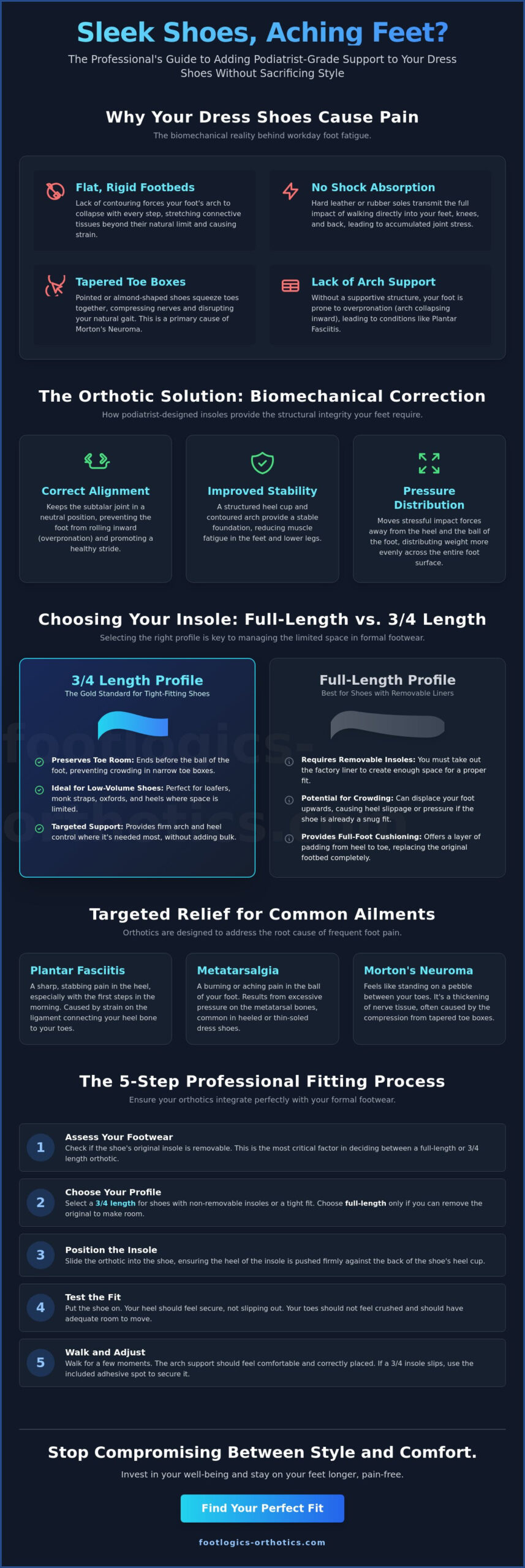
Dress shoes are designed for aesthetics first. High-quality leather and sleek silhouettes create a professional look, but the internal environment is often hostile to human anatomy. Most formal footwear features a completely flat footbed. This lack of contouring forces your foot to flatten out with every step. It stretches the connective tissues beyond their natural limit. While shoe inserts can bridge this gap, the base shoe rarely provides the necessary biomechanical foundation.
Traditional hard-soled shoes also lack shock absorption. Unlike sneakers with foam midsoles, leather or hard rubber soles transmit the full force of every step directly into your joints. If you spend eight hours on your feet, that repetitive impact accumulates. Many professionals believe they just need to “break in” their shoes to solve the problem. This is a myth. While leather softens over time, it never develops arch support on its own. Softening the material might reduce blisters, but it won’t stop your arches from collapsing. Adding specialized insoles for dress shoes is the only way to provide the structural integrity your feet require.
The Impact of Tapered Toe Boxes
The “almond” or “pointed” toe shape is a staple of professional style. Unfortunately, this design creates intense forefoot crowding. It pushes the big toe toward the smaller toes, compressing the metatarsal heads and the delicate nerves between them. This constant squeezing is a primary cause of Morton’s Neuroma, a painful condition that feels like standing on a sharp pebble. When your toes are restricted, they cannot splay naturally during the “toe-off” phase of your walk. This restriction disrupts the natural gait cycle by preventing the foot from transitioning into a rigid lever for propulsion, forcing the calf and ankle to work harder.
Lack of Longitudinal Arch Support
Most dress shoes use a rigid steel or plastic shank for structural stability. While this prevents the shoe from folding in half, it does nothing to support the longitudinal arch of your foot. Without a contoured surface, your foot is prone to overpronation, where the arch collapses inward. Gravity works against you during long periods of standing, causing the plantar fascia to pull away from the heel bone. This tension leads to the sharp, morning heel pain many associates with Plantar Fasciitis. High-quality insoles for dress shoes provide the following benefits:
- Alignment: They keep the subtalar joint in a neutral position.
- Stability: They prevent the foot from rolling inward or outward excessively.
- Pressure Distribution: They move weight away from the heel and ball of the foot.
The result is a more balanced stance and a significant reduction in late-day foot fatigue. Don’t wait for chronic pain to set in before addressing the lack of support in your formal footwear.
Full-Length vs. 3/4 Length: Choosing the Right Profile
Selecting the right profile for your orthotics is a matter of volume management. In footwear terms, volume refers to the total internal space available for your foot. Most formal footwear is considered “low-volume.” It’s designed to fit closely to the skin with minimal excess room. When you introduce insoles for dress shoes, you’re competing for that limited space. If the insole is too thick, it displaces your foot upward, leading to heel slippage or painful pressure across the top of the foot.
The goal is to find a balance between structural support and displacement. You need enough material to control overpronation, but not so much that you can’t comfortably close the shoe. This is why professional orthotics are categorized by their length and thickness. Choosing between a full-length and a 3/4 length model depends entirely on the specific construction of your footwear and whether the factory footbed is removable.
The 3/4 Length Advantage
For tight-fitting loafers, monk straps, or court shoes, 3/4 length orthotics are the gold standard. These inserts end just before the ball of the foot. They provide firm arch support and a stabilized heel cup without taking up a single millimeter of space in the toe box. This is critical for maintaining the original feel of the shoe’s front end. It prevents your toes from feeling crushed or restricted, which is a common complaint with generic inserts.
Placement is key for 3/4 length models. Because they don’t reach the end of the shoe, they can occasionally slip forward. High-quality versions often include a small adhesive strip on the underside to lock them into the heel seat. This ensures the arch support stays perfectly aligned with your anatomy throughout the day. If you’re wearing narrow shoes that don’t have a removable liner, a 3/4 length Plantar Fasciitis orthotic is often the most effective way to gain support without compromising fit.
Full-Length Slimline Orthotics
Full-length inserts are best suited for dress boots or modern oxfords that feature a removable factory footbed. Before buying, always check if you can pull out the existing foam liner. If you can, a full-length slimline orthotic is superior for overall shock absorption. It provides a consistent, cushioned surface from heel to toe, which is beneficial if you suffer from general foot fatigue or Metatarsalgia.
Achieving a perfect fit requires careful trimming. Don’t guess. Take the original factory insole out and place it on top of your new orthotic. Use it as a template and trim the edges with sharp scissors. This ensures an edge-to-edge fit that won’t bunch up or slide. This full-coverage approach is ideal for professionals who need maximum stability during high-impact movement or long commutes on hard city pavements.
Addressing Common Ailments: Relief for Plantar Fasciitis and Metatarsalgia
Living with chronic foot pain often feels like a distraction you can’t afford. When you’re in a boardroom or at a formal event, you need your focus on the task, not the throbbing in your arches. Most generic drugstore inserts rely on soft foam that bottoms out within weeks. For real relief, you need medical-grade insoles for dress shoes that use structural integrity to realign your gait. These orthotics don’t just cushion; they correct the biomechanical imbalances that lead to long-term injury.
One of the most critical features of a professional orthotic is the deep heel cup. It stabilizes the calcaneus (heel bone) to prevent it from rolling inward or outward. This stability is the first step in correcting overpronation. When your feet are properly aligned, it stops a negative chain reaction that often causes secondary pain in the knees, hips, and lower back. By providing a firm foundation, you ensure that every step you take is structurally sound.
Plantar Fasciitis Support in Formal Wear
Plantar Fasciitis is caused by the over-stretching of the connective tissue along the bottom of your foot. A flat dress shoe allows this tissue to strain with every step. You need a firm, longitudinal arch support to take the tension off the fascia. Soft cushions might feel comfortable initially, but they fail to provide the structural “bridge” your arch requires to heal. A contoured heel cup is a biomechanical necessity because it cradles the fatty pad under the calcaneus, preventing it from spreading and losing its natural shock-absorbing properties. This combination of arch height and heel stability is essential for waking up without that dreaded first-step pain.
Relieving Ball-of-Foot Pain (Metatarsalgia)
Dress shoes, especially those with a slight heel, shift your body weight forward. This puts immense pressure on the metatarsal heads, leading to a burning sensation or sharp pain in the ball of the foot. Choosing high-performance insoles for dress shoes with a built-in metatarsal raise can change your entire experience. This small, strategic lift sits just behind the ball of the foot to spread the metatarsal bones. It opens up the space between the joints, reducing friction and preventing nerve compression during the “toe-off” phase of your walk. The result is a significant reduction in the heat and pressure that typically builds up by mid-afternoon.
Don’t settle for temporary fixes. Medical-grade materials like high-density EVA or specialized polymers maintain their shape under your body weight. They provide the consistent, predictable support necessary to manage chronic conditions while you’re on the clock. Investing in professional-grade support means you can stop managing pain and start focusing on your career.
The 5-Step Guide to Fitting Insoles in Tight Formal Footwear
Don’t follow the common advice to “just buy a size up” when using orthotics. Sizing up leads to heel slippage, blisters, and a sloppy fit that ruins your professional look. Precision is the goal. Use this methodical approach to integrate insoles for dress shoes into your existing wardrobe without compromising the silhouette.
- Step 1: Check the factory footbed. Determine if the internal liner is glued down or removable. If it’s removable, take it out to create maximum volume for your new orthotic.
- Step 2: Assess heel counter depth. Measure how high the back of the shoe sits. A shallow heel counter requires an ultra-slim insert to prevent your heel from popping out.
- Step 3: Select the right thickness. Choose an ultra-slim profile for tight oxfords. Save standard thickness for dress boots or roomier footwear.
- Step 4: Test with the right socks. Always perform your fitting with the exact dress socks you wear to work. Even a slight change in hosiery thickness affects the final fit.
- Step 5: Monitor for heel lift. Walk around the room. If your heel feels insecure, you may need a thinner profile or a 3/4 length model.
Fitting Oxfords and Derbies
Laced shoes offer the most flexibility. You can leverage the adjustable lacing system to accommodate the added volume of an insert. When placing your insoles for dress shoes, ensure the peak of the orthotic arch aligns perfectly with your natural foot arch. If you feel pressure on the bridge of your foot, the “instep” height is too high. Loosening the bottom laces often provides the necessary relief without sacrificing stability.
Loafers and Slip-Ons: A Unique Challenge
Loafers provide no room for adjustment. This makes 3/4 length orthotics almost mandatory for slip-ons. Because these shoes lack laces, adding a full-length insert often causes “pumping,” where your heel slips out with every step. To keep your support secure, use small adhesive dots on the underside of the insert. This prevents migration during long walks between meetings. For the best results, browse our range of Work Orthotics designed specifically for low-profile footwear.
Footlogics: Podiatrist-Designed Support for Professional Life
Footlogics represents the intersection of clinical expertise and daily utility. With over 2 million pairs sold worldwide, our reputation is built on a foundation of proven results. We don’t just sell cushions; we provide medical-grade solutions for people who spend their lives on their feet. While drugstore inserts rely on soft foam that collapses under pressure, our orthotics utilize high-density materials designed to maintain their structural integrity for years. This durability ensures that your support doesn’t fade halfway through a busy quarter. Our engineering focuses on realigning the subtalar joint, which is the key to preventing the overpronation discussed in previous sections.
We understand that the professional world demands a certain aesthetic. You shouldn’t have to choose between a polished appearance and physical well-being. Our mission is to provide a pathway to wellness that fits seamlessly into your existing lifestyle. By choosing professional-grade insoles for dress shoes, you’re investing in a long-term solution rather than a temporary fix. We stand behind our products with a 30-day money-back guarantee. This allows you to test the support in your own shoes, on your own schedule, completely risk-free.
Engineered for Low-Volume Shoes
Traditional orthotics are often too bulky for formal footwear. They crowd the foot and ruin the line of a well-made shoe. Footlogics has solved this with slimline designs specifically calibrated for low-volume environments. These inserts provide the same biomechanical correction as our athletic models but with a significantly reduced profile. You get the deep heel cup and longitudinal arch support required to manage Plantar Fasciitis without the bulk that leads to heel slippage. Check out our work orthotics for long-shift support to find the right balance of correction and concealment for your professional wardrobe.
Why Thousands of Professionals Trust Footlogics
The difference lies in our podiatrist-developed geometry. Unlike retail foam that offers only surface-level softness, our orthotics are shaped to mirror the natural contours of a healthy foot. This precision helps distribute weight evenly across the entire footbed, effectively eliminating the “hot spots” that cause burning sensations in the ball of the foot. When you order from us, you’re supported by our dedicated fulfillment team. We ensure that your professional-grade insoles for dress shoes are processed quickly and accurately. We also offer free worldwide shipping to make high-quality foot health accessible to everyone. Ready to transform your workday comfort? Find your perfect pair of dress shoe insoles here and experience the confidence that comes with a pain-free stride.
Step Into Professional Comfort Without Compromise
Your workday shouldn’t be defined by the pain in your feet. We’ve explored how the flat, rigid construction of formal footwear leads to chronic strain and why managing shoe volume is the secret to a perfect fit. By choosing the right profile and following our 5-step fitting guide, you can finally enjoy medical-grade support in your favorite oxfords or loafers. High-performance insoles for dress shoes bridge the gap between professional style and biomechanical health.
Footlogics provides the expertise you need to stay active and focused. Our podiatrist-developed orthotics have helped over 2 million people worldwide reclaim their comfort. We believe in our engineering so much that we offer a full money-back guarantee on every pair. It’s time to stop enduring discomfort and start investing in your long-term wellness. Shop Podiatrist-Designed Insoles for Dress Shoes today and experience the difference that professional alignment makes. Your feet will thank you at the end of every shift.
Frequently Asked Questions
Do insoles actually fit in narrow dress shoes?
Yes, provided you choose an ultra-slim or 3/4 length profile. These designs are specifically engineered for low-volume footwear where space is limited. They provide essential biomechanical support without the bulk of standard athletic inserts. You can gain professional-grade arch support even in the sleekest oxfords or tapered heels without ruining the shoe’s silhouette.
Can I use full-length orthotics in shoes without removable insoles?
It’s generally not recommended to place full-length orthotics on top of a fixed factory footbed. Doing so creates too much bulk and displaces your foot upward, which leads to heel slippage and a tight instep. If your dress shoes don’t have a removable liner, a 3/4 length model is the superior choice. It provides support while leaving the forefoot area original and uncrowded.
How do I stop my heel from slipping out of my dress shoes with insoles?
Heel slippage usually happens when an insert is too thick for the shoe’s heel counter. To stop this, ensure you’re using a slimline profile designed for formal wear. If the slipping persists, try a 3/4 length model that doesn’t lift the entire foot. You can also use small adhesive dots on the underside of the insole to keep it from migrating forward as you walk.
Are 3/4 length insoles better than full-length for loafers?
Yes, 3/4 length insoles for dress shoes are the preferred choice for loafers and other slip-on styles. Because loafers have no laces for adjustment, they offer very little room for error in volume. A 3/4 length insert provides the necessary arch and heel stability while leaving the toe box completely free. This maintains the original fit and prevents your toes from feeling crushed.
How long do medical-grade dress shoe insoles typically last?
High-quality orthotics usually last between 12 and 18 months with daily professional use. Because they’re made from high-density EVA or specialized polymers, they maintain their shape much longer than cheap drugstore foam. You’ll know it’s time for a replacement when you notice a decrease in arch support or visible compression in the heel area. Investing in durability pays off in long-term comfort.
Will adding an insole make my dress shoes feel too tight across the top?
It can if the insole is too thick for the shoe’s internal volume. To prevent a tight feeling across the instep, select an ultra-slim orthotic or a 3/4 length model. These specialized designs focus on support in the arch and heel without adding unnecessary height to the front of the foot. This ensures your shoes remain comfortable throughout a long shift.
Do I need to buy dress shoes a half-size larger to accommodate insoles?
No, you should buy your true size and select insoles for dress shoes specifically engineered for low-volume profiles. Sizing up is often bad advice because it leads to poor foot alignment and painful blisters. Proper fitting is about managing the internal space of the shoe, not changing the external size. A well-chosen slimline orthotic should integrate perfectly with your standard shoe size.
Can dress shoe insoles help with lower back pain?
Yes, by correcting overpronation and realigning the subtalar joint. When your feet collapse inward, it creates a negative chain reaction that rotates your legs and tilts your pelvis. This misalignment often results in chronic strain on your knees, hips, and lower back. By providing a stable foundation, professional orthotics help maintain a neutral posture and reduce the physical fatigue caused by long periods of standing.
What our Customers say
REAL RELIEF. REAL RESULTS.
Proven support, trusted by millions.
“Instant comfort and support from
the very first wear.”
Adam Smith

