
Common Pickleball Injuries and How to Prevent Them
Pickleball is one of the fastest-growing sports in the country, and it’s easy to see why. It’s social, it’s accessible, and you can pick up a paddle and start rallying within minutes of learning the rules. But that same accessibility is part of what makes it so hard on the body. Unlike sports with a longer on-ramp, many players go from zero to several sessions a week almost immediately, often without the conditioning base to handle the sport’s stop-start, side-to-side demands. The result: emergency rooms and physical therapy clinics across the country have reported a steady rise in pickleball-related injuries as the sport’s popularity has climbed.
The good news is that most pickleball injuries are preventable once you understand what’s actually causing them. Here’s a breakdown of the most common issues, why they happen, and what actually helps.
Why Pickleball Is Uniquely Hard on the Body
Pickleball’s small court creates an illusion of low intensity. In reality, the smaller court means less time to react and more abrupt changes of direction packed into a shorter space. A typical point involves short sprints to the net, sudden stops, lateral shuffles along the kitchen line, and lunges to reach wide shots, all repeated dozens of times per game, often on hard acrylic or concrete surfaces that provide little shock absorption.
Add in the sport’s popularity among players over 40 (who make up a large share of the pickleball boom) and you have a recipe for overuse injuries: bodies that may not have trained explosively in years, suddenly asked to do so multiple times a week.
The Most Common Pickleball Injuries
Ankle sprains. The most frequently reported pickleball injury, typically caused by rolling the ankle during a lateral shuffle or a sudden change of direction. Worn court shoes, inadequate lateral support, and fatigue late in matches all increase risk.
Plantar fasciitis. Sharp heel pain, often worst with the first steps in the morning, caused by repeated strain on the band of tissue running along the bottom of the foot. The constant stopping and pivoting in pickleball places direct, repetitive load on this structure.
Achilles tendonitis. Pain and stiffness at the back of the heel, driven by the sport’s short, explosive sprints and quick stops, which repeatedly load the Achilles tendon under tension.
Tennis elbow (despite the name). Surprisingly common in pickleball due to the repetitive wrist-and-forearm motion of dinking and volleying, especially among players who grip the paddle too tightly or haven’t built up forearm endurance.
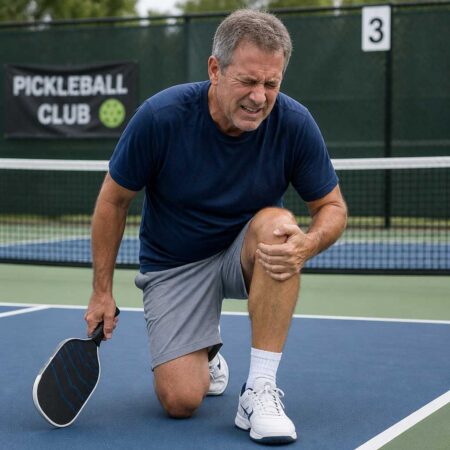
Knee pain, including patellofemoral pain syndrome. Often develops as a secondary effect of poor foot alignment. When the arch collapses inward during play (over-pronation), it creates a chain reaction of rotational stress up through the shin and into the knee.
Metatarsalgia and Morton’s Neuroma. Burning, aching, or tingling under the ball of the foot, caused by repeated forefoot loading during push-offs and quick pivots. Worse in players who spend a lot of time at the non-volley zone line.
Rotator cuff strain. Less common but seen in players who serve or overhead-smash frequently without adequate shoulder conditioning.
What Actually Prevents These Injuries
Warm up properly, every time. A 5-minute routine of light jogging, dynamic calf raises, ankle circles, and walking lunges prepares tissues for explosive movement far better than walking straight onto the court cold. This single habit prevents a meaningful share of soft-tissue injuries.
Wear real pickleball or court shoes, not running shoes. Running shoes are built for forward motion. Pickleball’s lateral demands need a shoe with a wider base and more built-in stability, since running shoes tend to offer minimal side-to-side support and can actually increase ankle-roll risk.
Support your feet from the ground up. Since so many pickleball injuries, from plantar fasciitis to knee pain, trace back to how the foot is loading during lateral movement, a supportive insole with real arch structure and a stabilizing heel cup addresses the root mechanical issue rather than just the symptom. This is exactly the gap that factory shoe insoles, which are usually just thin comfort foam, don’t fill.
Build in strength and mobility work, not just match play. Basic exercises like calf raises, single-leg balance drills, and lateral band walks, done two or three times a week, build the stabilizing strength that court play alone doesn’t develop.
Progress your playing frequency gradually. Jumping from zero to five sessions a week is one of the single biggest predictors of overuse injury. Building up over several weeks gives tendons and connective tissue time to adapt.
Replace worn shoes and insoles on schedule. Check court shoes every 6–9 months for flattened outsoles or collapsed heel counters. A shoe that’s lost its structure can’t do its job, no matter how good the insole inside it is.
Know when to rest. Morning heel pain, persistent tingling in the toes, or aching that doesn’t resolve within a day or two of rest are signals to scale back, not push through. Early intervention is almost always faster and cheaper than treating a chronic injury.
The Bottom Line
Most pickleball injuries share a common thread: repeated stress on tissues and joints that weren’t given enough support or recovery time to handle the sport’s unique lateral demands. A proper warm-up, appropriate footwear, gradual progression, and genuine arch and heel support go a long way toward keeping you on the court instead of in a physical therapist’s waiting room.
If foot pain, heel discomfort, or forefoot burning is already part of your pickleball routine, it’s worth looking at what’s actually happening underneath your foot during play. Footlogics ACTIVE insoles are podiatrist-designed specifically to address the medial and lateral stresses of court sports, and they’re backed by a 30-day money-back guarantee if they’re not the right fit for your feet.
What our Customers say
REAL RELIEF. REAL RESULTS.
Proven support, trusted by millions.
“Instant comfort and support from
the very first wear.”
Adam Smith
<script type="application/ld+json">
{
"@context":"https://schema.org",
"@type":"FAQPage",
"mainEntity":[
{
"@type":"Question",
"name":"What age can children start wearing orthotic insoles?",
"acceptedAnswer":{
"@type":"Answer",
"text":"Children can begin wearing orthotic insoles whenever they are recommended by a podiatrist or healthcare professional. There is no specific minimum age, as treatment depends on foot development and symptoms rather than age alone."
}
},
{
"@type":"Question",
"name":"Do all children with flat feet need orthotics?",
"acceptedAnswer":{
"@type":"Answer",
"text":"No. Many young children naturally have flexible flat feet that develop normal arches over time. Orthotics are usually recommended only when flat feet are causing pain, fatigue or functional problems."
}
}
]
}
</script>
