Achilles Tendonitis Exercises: A Step-by-Step Rehabilitation Guide
Achilles tendonitis can make walking, running, climbing stairs, and even getting out of bed uncomfortable. Pain and stiffness at the back of the heel are common symptoms, particularly after physical activity or first thing in the morning.
Fortunately, progressive strengthening exercises are among the most effective treatments for Achilles tendinopathy, the medical term commonly used for persistent Achilles tendon pain.
Research shows that gradually loading the Achilles tendon can help improve calf strength, tendon function, and tolerance for everyday activities.
However, not all Achilles exercises are suitable for everyone. The location of your pain, how long you have experienced symptoms, and your current strength all influence which exercises are appropriate.
This guide explains seven commonly used Achilles tendon rehabilitation exercises, including eccentric heel drops, calf raises, and gentle stretches. It also explains when to perform them, how to progress safely, and which exercises to avoid.
Why Are Exercises Important for Achilles Tendonitis?
The Achilles tendon connects the calf muscles to the heel bone. It transfers force from the calf muscles to the foot, allowing you to walk, run, jump, and rise onto your toes.
When the tendon becomes painful, people often reduce their activity to avoid discomfort.
Although temporarily reducing aggravating activities can help, prolonged inactivity may decrease calf strength and the tendon’s ability to tolerate physical stress.
Modern rehabilitation therefore emphasizes progressive tendon loading rather than complete rest.
Progressive loading means gradually increasing the demands placed on the calf muscles and Achilles tendon as symptoms and strength improve.
This approach can help:
-
Improve calf muscle strength and endurance.
-
Increase the tendon’s tolerance for everyday activity.
-
Reduce pain and stiffness over time.
-
Restore walking, running, and sporting function.
-
Support a gradual return to normal activities.
The 2024 Achilles Tendinopathy Clinical Practice Guideline, published in the Journal of Orthopaedic & Sports Physical Therapy, recommends tendon-loading exercise as a first-line treatment for midportion Achilles tendinopathy.
The guideline emphasizes that loading programs should be individualized rather than assuming that one exercise or technique is best for everyone.
Read the 2024 Achilles Tendinopathy Clinical Practice Guideline.
Before You Begin: Identify Where Your Achilles Hurts
There are two main types of Achilles tendinopathy, and the distinction is important when choosing exercises.
Midportion Achilles Tendinopathy
Pain typically occurs approximately 2–6 cm above the heel bone, along the middle portion of the Achilles tendon.
This type often responds well to progressive calf strengthening, including exercises involving controlled heel raising and lowering.
Some patients may eventually benefit from heel drops performed on a step.
Insertional Achilles Tendinopathy
Pain occurs at the point where the Achilles tendon attaches to the back of the heel bone.
This area can become irritated when the ankle bends upward excessively, increasing compression at the tendon attachment.
If you have insertional Achilles tendinopathy, avoid lowering your heel below the level of a step unless a qualified clinician specifically recommends it.
Heel raises performed on flat ground are generally a more appropriate starting point.
If you are unsure which type you have, consult a healthcare professional before beginning a rehabilitation program.
For a broader explanation of available treatments, read our Achilles Tendonitis Treatment Guide.
7 Achilles Tendonitis Exercises for Rehabilitation
The following exercises are commonly used in Achilles rehabilitation. They are not intended to be performed as one complete routine by every patient.
Begin with exercises suited to your symptoms and ability, then progress gradually. The suggested repetitions are general examples rather than an individualized prescription.
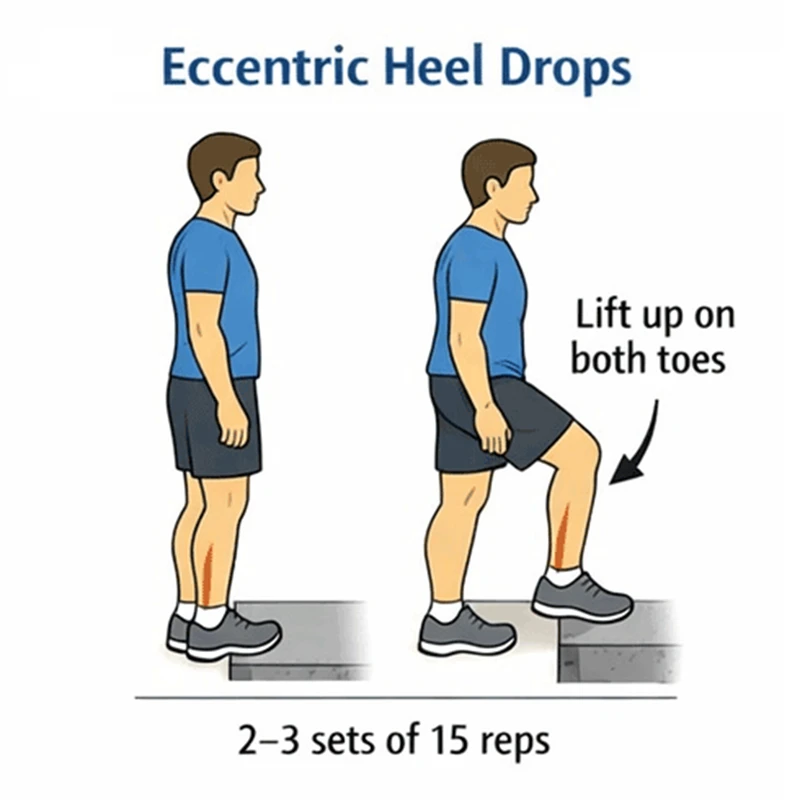
Exercise 1: Eccentric Heel Drops
Best suited for: Selected patients with midportion Achilles tendinopathy who can tolerate loading on a step.
Eccentric heel drops involve slowly lowering the heel while the calf muscles lengthen under load.
They are among the most widely studied exercises for Achilles tendinopathy.
How to perform eccentric heel drops
-
Stand on a sturdy step with the balls of your feet supported and your heels near the edge. Hold a handrail for balance.
-
Rise onto your toes using both feet.
-
Transfer your weight onto the affected leg, if comfortable.
-
Slowly lower the affected heel over approximately 3–5 seconds.
-
Use both feet to return to the raised position.
-
Repeat according to your rehabilitation plan.
A clinician may begin with a small number of repetitions and gradually progress toward sets of 10–15, depending on symptoms and strength.
Traditional eccentric protocols often involve substantially more repetitions, but these are not necessary or appropriate for every patient.
Important: Do not perform heel drops below step level if you have insertional Achilles tendinopathy unless specifically instructed by your clinician.
The American Academy of Orthopaedic Surgeons (AAOS) explains this distinction in its Achilles tendinitis patient guidance.
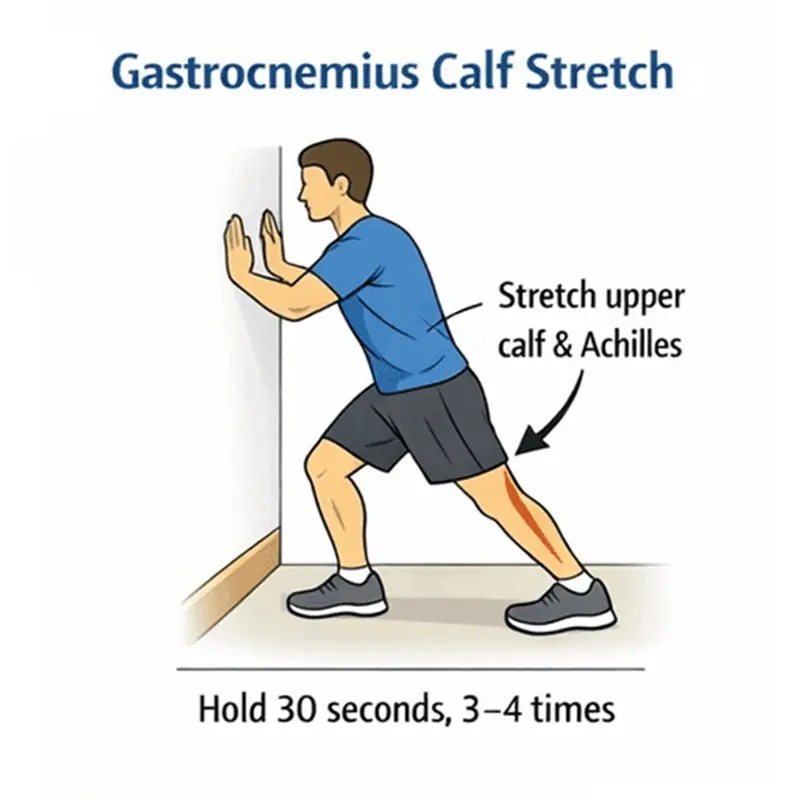
Exercise 2: Gastrocnemius Calf Stretch
Best suited for: People with limited calf flexibility who can stretch without aggravating their Achilles pain.
Insert existing Footlogics illustration: Gastrocnemius Calf Stretch.
The gastrocnemius is the larger, more superficial calf muscle. It crosses both the knee and ankle joints.
A gentle stretch may help improve ankle mobility when calf tightness is present.
How to perform the stretch
-
Stand facing a wall and place both hands against it.
-
Step the affected leg backward.
-
Keep the rear knee straight and the heel on the ground.
-
Gently lean toward the wall until you feel a comfortable stretch in the upper calf.
-
Hold for approximately 20–30 seconds.
-
Relax and repeat two or three times if comfortable.
Avoid bouncing or forcing the ankle into a painful position.
Important: Stretching is an optional addition to rehabilitation, not a substitute for strengthening. People with insertional Achilles pain may need to limit or avoid this stretch.
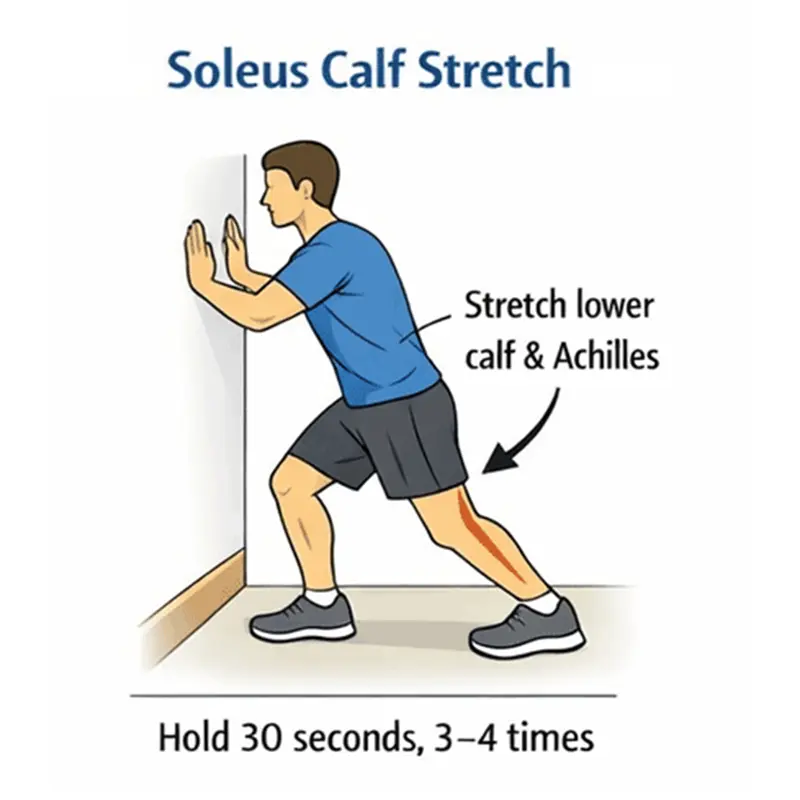
Exercise 3: Soleus Calf Stretch
Best suited for: Selected patients with restricted ankle mobility who tolerate gentle stretching.
Insert existing Footlogics illustration: Soleus Calf Stretch.
The soleus is a deeper calf muscle that plays an important role in walking, running, and supporting the body during standing.
Unlike the gastrocnemius, the soleus does not cross the knee joint.
Bending the knee during a calf stretch places greater emphasis on the soleus.
How to perform the stretch
-
Stand facing a wall with the affected leg behind you.
-
Keep the rear heel on the ground.
-
Gently bend the rear knee.
-
Move your body forward until you feel a comfortable stretch lower in the calf.
-
Hold for approximately 20–30 seconds.
-
Repeat two or three times if comfortable.
Avoid forcing the ankle into deep dorsiflexion.
Important: This stretch may aggravate insertional Achilles tendinopathy because it increases ankle dorsiflexion. It should be modified or avoided if it causes pain at the tendon attachment.
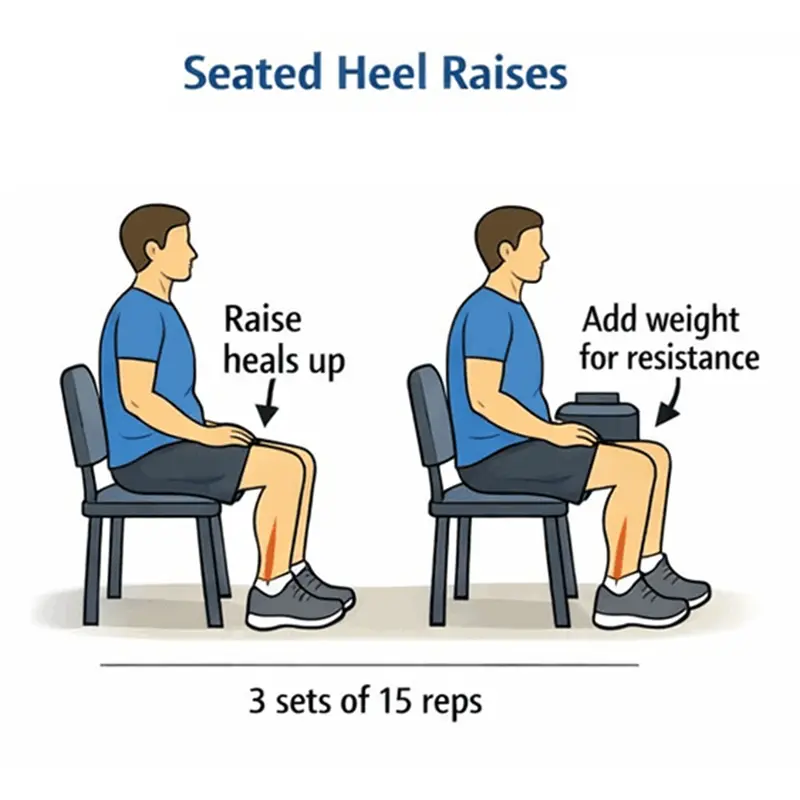
Exercise 4: Seated Heel Raises
Best suited for: People beginning calf strengthening or those progressing toward heavier resistance exercises.
Insert existing Footlogics illustration: Seated Heel Raises.
Seated heel raises strengthen the calf muscles, particularly the soleus.
Because the knee remains bent, this exercise provides a useful way to train the deeper calf muscles.
How to perform seated heel raises
-
Sit upright in a sturdy chair with both feet flat on the floor.
-
Keep your knees bent at approximately 90 degrees.
-
Slowly lift your heels while keeping the balls of your feet on the ground.
-
Pause briefly at the top.
-
Lower your heels in a controlled manner.
-
Repeat for a comfortable number of repetitions.
A starting point might be one or two sets of 8–12 repetitions, adjusted according to symptoms.
As strength improves, resistance can be increased gradually using an appropriate weight positioned securely over the thighs.
Avoid adding heavy resistance without adequate control or professional guidance.
Seated heel raises can form an important part of a progressive strengthening program, but they should not be considered the only exercise required for rehabilitation.
Exercise 5: Standing Double-Leg Heel Raises
Best suited for: Building basic calf strength and progressing toward more demanding exercises.
Standing heel raises strengthen the gastrocnemius, soleus, and Achilles tendon through a functional movement.
They can be performed on flat ground and are often easier to control than single-leg heel raises.
How to perform standing heel raises
-
Stand with your feet approximately hip-width apart.
-
Hold a sturdy chair or countertop for balance.
-
Slowly rise onto the balls of both feet.
-
Pause briefly at the top.
-
Lower your heels to the floor in a controlled manner.
-
Repeat according to your symptoms and ability.
Begin with a manageable number of repetitions, such as one or two sets of 8–12.
As the exercise becomes easier, gradually increase the number of repetitions or resistance.
For insertional Achilles tendinopathy, keep the movement on flat ground rather than allowing the heels to drop below floor level.
Exercise 6: Single-Leg Heel Raises
Best suited for: Patients who can comfortably perform double-leg heel raises and are ready for greater loading.
Single-leg heel raises increase the load placed on the calf muscles and Achilles tendon.
They are useful for developing the strength required for walking uphill, running, and more demanding physical activities.
How to perform single-leg heel raises
-
Stand beside a stable support.
-
Shift your weight onto the affected leg.
-
Keep your knee comfortably straight.
-
Slowly rise onto the ball of your foot.
-
Pause briefly.
-
Lower your heel in a controlled manner.
-
Repeat while maintaining good balance and technique.
Start with a small number of repetitions and increase gradually as tolerated.
If you cannot perform the movement without significant pain or loss of control, continue with double-leg heel raises until your strength improves.
A physical therapist may also recommend performing single-leg heel raises with a slightly bent knee to emphasize different calf muscle demands.
Exercise 7: Isometric Calf Raise Holds
Best suited for: Some patients who find repeated calf movements uncomfortable or need an alternative loading option.
Isometric exercises involve contracting a muscle while holding a relatively fixed position.
An isometric calf raise can provide a way to load the calf muscles without repeatedly moving through the ankle’s full range of motion.
How to perform an isometric calf hold
-
Stand on flat ground near a sturdy support.
-
Rise slightly onto the balls of both feet.
-
Hold the position without bouncing.
-
Maintain a comfortable level of effort.
-
Slowly lower your heels to the floor.
A short hold of approximately 10–20 seconds may be a reasonable starting point for some patients, with duration and effort progressed according to tolerance.
Isometric exercises are not proven to provide immediate pain relief for everyone. Their main role is as one possible component of a broader strengthening program.
How Often Should You Perform Achilles Tendonitis Exercises?
The ideal frequency depends on the exercise, your symptoms, and the stage of rehabilitation.
Some low-intensity movements may be performed more frequently, while heavier strengthening exercises generally require more recovery time between sessions.
The 2024 clinical practice guideline supports tendon-loading exercise at least three times per week for midportion Achilles tendinopathy, using loads as high as the patient can tolerate.
However, that recommendation does not mean performing all seven exercises three times weekly.
A rehabilitation program may progress through the following stages:
A rehabilitation program may progress
through the following stages:
| Stage | Main goal | Examples |
|---|---|---|
| Early rehabilitation | Restore comfortable loading | Supported heel raises, seated heel raises, selected isometric holds |
| Progressive strengthening | Build calf strength and tendon capacity |
Double-leg and single-leg heel raises, increasing resistance |
| Advanced rehabilitation | Prepare for demanding activity | Heavier calf strengthening, faster movements and controlled hopping |
| Return to sport | Restore sport-specific tolerance | Graduated running, jumping and change-of-direction drills |
Progression should depend on symptoms,
strength, and function rather than
following a rigid calendar.
Should Achilles Tendonitis Exercises Hurt?
Some discomfort during tendon rehabilitation can be acceptable.
However, the idea that exercise must be completely pain-free is not always consistent with modern Achilles tendinopathy rehabilitation.
A commonly used approach involves monitoring pain during exercise and evaluating the tendon’s response afterward.
The most important warning sign is a substantial increase in symptoms that persists after exercise or into the following day.
For example, if morning stiffness becomes significantly worse after a strengthening session, the tendon may not have tolerated the previous load.
In that situation, reduce the intensity, volume, or range of motion and seek professional guidance if symptoms persist.
Do not continue exercising through sharp, sudden, or severe pain.
Exercises to Avoid or Modify With Achilles Tendonitis
Certain activities can aggravate Achilles symptoms, particularly during early rehabilitation.
These may include:
-
Aggressive heel drops below step level in people with insertional Achilles tendinopathy.
-
Forceful calf stretching that reproduces heel pain.
-
Sudden increases in running distance or speed.
-
Repeated sprinting or jumping before adequate strength has returned.
-
Heavy calf exercises performed with poor control.
-
Continuing demanding exercise despite worsening symptoms.
The goal is not to avoid these activities permanently. Rather, they should be introduced or modified according to the tendon’s current loading capacity.
How Long Do Achilles Exercises Take to Work?
Achilles tendon rehabilitation is usually a gradual process.
Some people notice reduced discomfort and improved walking tolerance within several weeks.
However, meaningful improvements in tendon strength and function often take several months.
Persistent Achilles tendinopathy may require six months or longer of structured rehabilitation, especially when symptoms have been present for an extended period.
Progress is rarely perfectly linear. Temporary flare-ups can occur even when rehabilitation is working.
Consistency, gradual progression, and avoiding sudden increases in activity are more useful than attempting to achieve rapid results.
For more information about recovery times and treatment options, see our Achilles Tendonitis Treatment Guide.
Learn More About Achilles Tendonitis and Orthotic Support
While strengthening exercises are an important part of Achilles tendonitis rehabilitation, understanding the underlying causes of tendon pain is equally important. Factors such as training habits, footwear and foot biomechanics may contribute to Achilles tendon problems. For some people, supportive footwear and orthotic insoles may help improve comfort and reduce certain mechanical stresses on the foot and ankle.
To learn more about the causes, symptoms and potential benefits of orthotic support, visit our comprehensive guide to Achilles Tendonitis and Orthotic Insoles.
Frequently Asked Questions About Achilles Tendonitis Exercises
What is the best exercise for Achilles tendonitis?
Progressive calf strengthening is generally the most important exercise-based treatment for midportion Achilles tendinopathy. Heel raises and controlled heel-lowering exercises are commonly used. The best choice depends on the location of pain and the patient’s current ability.
Are eccentric heel drops better than regular calf raises?
Eccentric heel drops are well studied, but research has not consistently demonstrated that they are superior to all other progressive strengthening approaches. Both eccentric and combined lifting-and-lowering exercises can be useful.
Can I do Achilles tendon exercises every day?
Some gentle exercises may be performed daily, but heavier strengthening sessions often require recovery time. Exercise frequency should reflect the intensity of loading and the tendon’s response.
Should I stretch a painful Achilles tendon?
Gentle stretching may be appropriate for some people with limited calf flexibility. However, stretching is not the primary treatment, and aggressive stretching can aggravate symptoms, particularly in insertional Achilles tendinopathy.
Are heel raises good for Achilles tendonitis?
Yes. Heel raises are commonly used to progressively strengthen the calf muscles and improve the Achilles tendon’s tolerance for loading. They should be introduced and progressed according to symptoms.
Can I walk while recovering from Achilles tendonitis?
Walking is often possible if pain remains manageable and symptoms do not worsen significantly afterward. Reduce walking distance, speed, or hills when necessary.
How do I know if my Achilles tendon is getting stronger?
Signs of progress may include improved tolerance for walking, less morning stiffness, the ability to perform more controlled heel raises, and improved strength during everyday activities.
When should I stop exercising and seek medical help?
Stop and seek urgent assessment if you experience a sudden pop or snap, severe pain, sudden weakness, or difficulty pushing off your foot. These symptoms may indicate an Achilles tendon rupture. Persistent or worsening symptoms also warrant professional assessment.
Final Advice: Strengthen Gradually and Stay Consistent
Achilles tendonitis exercises can play a central role in recovery, particularly when they are part of a structured, progressive strengthening program.
The most important principles are straightforward: begin at an appropriate level, increase loading gradually, monitor your symptoms, and allow sufficient recovery between demanding sessions.
Remember that midportion and insertional Achilles tendinopathy may require different exercise modifications, especially when performing heel drops and calf stretches.
For persistent symptoms, a physical therapist or other qualified healthcare professional can help develop an individualized program.
You can also explore our Achilles Tendonitis Overview for information about symptoms, causes, footwear, and orthotic support.
Medical References
-
Chimenti RL, et al. (2024). Achilles Pain, Stiffness, and Muscle Power Deficits: Midportion Achilles Tendinopathy Revision — 2024. Journal of Orthopaedic & Sports Physical Therapy. Clinical Practice Guideline.
-
American Academy of Orthopaedic Surgeons (AAOS). Achilles Tendinitis. AAOS Orthopaedic Information.
-
Guy’s and St Thomas’ NHS Foundation Trust. Achilles Tendinopathy. NHS Patient Information.
Medical disclaimer: This article provides general educational information and is not a substitute for professional medical advice. Exercise selection and progression should be individualized. Seek urgent medical attention if an Achilles tendon rupture is suspected.