
Flat Feet vs. Fallen Arches vs. Over-Pronation: What’s the Difference?
If you’ve spent any time researching foot pain, you’ve probably run into these three terms used almost interchangeably: flat feet, fallen arches, and over-pronation. They’re closely related, and it’s genuinely common to have all three at once, but they describe different things. Understanding the distinction actually matters, because it affects what kind of support your foot needs.
The Short Answer
Flat feet and fallen arches describe the same physical structure, low or absent arches, but the terms hint at different origins. Over-pronation describes a movement, not a foot shape. You can have flat feet and not over-pronate much; you can over-pronate without technically having flat feet. Most people with flat feet do over-pronate, which is why the terms get blurred together so often.
Flat Feet: A Structural Description
“Flat feet,” medically known as pes planus, describes the physical shape of the foot: a low or absent medial arch, meaning most or all of the sole makes contact with the ground when standing.
There are two versions:
- Flexible flat feet — an arch is visible when sitting or on tiptoes, but disappears once weight is applied. This is the more common form.
- Rigid flat feet — no arch is visible even without weight-bearing. This version is less common and can sometimes indicate an underlying structural or joint issue worth having assessed.
Flat feet can be present from birth or develop later in life due to aging, weight gain, pregnancy, injury, or the gradual weakening of the tendons that support the arch.
Fallen Arches: The Same Condition, Different Framing
“Fallen arches” is essentially another name for the same structural issue, arches that are lower than typical, but it’s often used specifically to describe arches that used to be more developed and have since dropped, rather than arches that were always low. In practice, most people (and most product descriptions, including on our own site) use “flat feet” and “fallen arches” interchangeably, and there’s no meaningful clinical difference in how they’re treated.
Fallen arches affect a large share of the adult population, more so than people typically expect, and become more common with age as the connective tissue and tendons supporting the arch gradually lose some of their tension.
Over-Pronation: A Pattern of Movement, Not a Foot Shape
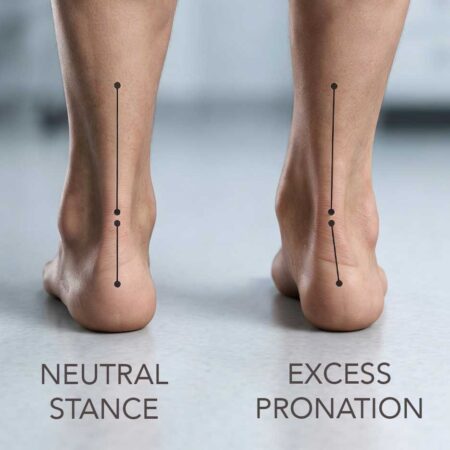
This is where the real distinction lies. Pronation itself is completely normal, it’s the natural inward roll of the foot that happens with every step, helping the foot absorb shock as it hits the ground. In a typical gait, the foot pronates briefly on impact, then supinates (rolls back outward) to prepare for push-off.
Over-pronation happens when that inward roll is excessive or lasts too long in the gait cycle. Instead of the foot correcting itself and supinating for propulsion, it keeps rolling inward, and the arch flattens more than it should with each step.
Importantly, over-pronation is about how the foot moves, not what it looks like standing still. This is why:
- Someone with a structurally normal arch can still over-pronate, especially under the added stress of running or high-impact activity
- Someone with flat feet doesn’t automatically over-pronate to a problematic degree, though it’s common
Why the Distinction Actually Matters for Choosing Support
If your issue is primarily structural (flat feet or fallen arches), the priority is an insole with enough arch height and contour to fill the gap your foot’s natural arch isn’t providing, restoring a more supported shape underfoot.
If your issue is primarily about movement (over-pronation, even with a relatively normal-looking arch), the priority shifts slightly toward motion control, a firmer arch shell and a deep, stabilizing heel cup that actively resists the inward roll during the gait cycle, rather than just filling space.
In practice, most supportive orthotic insoles, including the Footlogics range, address both at once: structural arch support that also happens to control excess pronation, since the two so often occur together. But if you’re trying to understand why a particular insole is recommended for your situation, or why one arch height feels different from another, it helps to know which of the two problems (shape or movement) is actually driving your symptoms.
How to Tell Which You’re Dealing With
A simple way to get a rough sense at home: wet the sole of your foot and step onto a piece of paper or a dark surface. If you see almost the full outline of your foot with little or no narrowing in the middle, that points toward flat feet or fallen arches. To check for over-pronation specifically, look at a pair of your older, well-worn shoes: excessive wear concentrated on the inner edge of the sole, particularly near the ball of the foot, is a common sign of over-pronation during your gait.
Neither test replaces an actual assessment from a podiatrist, but they’re a reasonable starting point for understanding which of these related-but-different issues you’re actually managing.
The Bottom Line
Flat feet and fallen arches are two names for the same structural reality: an arch that’s lower than typical. Over-pronation is a separate, related concept describing how much your foot rolls inward as you move. Most people dealing with foot pain have some combination of both, which is exactly why a well-designed orthotic insole is built to address structure and motion control together, rather than treating them as entirely separate problems.
If you’re trying to find the right level of support for your specific foot, our flat feet insole guide breaks down which Footlogics option fits different arch types, activities, and footwear.
What our Customers say
REAL RELIEF. REAL RESULTS.
Proven support, trusted by millions.
“Instant comfort and support from
the very first wear.”
Adam Smith
<script type="application/ld+json">
{
"@context":"https://schema.org",
"@type":"FAQPage",
"mainEntity":[
{
"@type":"Question",
"name":"What age can children start wearing orthotic insoles?",
"acceptedAnswer":{
"@type":"Answer",
"text":"Children can begin wearing orthotic insoles whenever they are recommended by a podiatrist or healthcare professional. There is no specific minimum age, as treatment depends on foot development and symptoms rather than age alone."
}
},
{
"@type":"Question",
"name":"Do all children with flat feet need orthotics?",
"acceptedAnswer":{
"@type":"Answer",
"text":"No. Many young children naturally have flexible flat feet that develop normal arches over time. Orthotics are usually recommended only when flat feet are causing pain, fatigue or functional problems."
}
}
]
}
</script>
