
What are the best orthotic insoles for plantar fasciitis?
What are the best insoles for plantar fasciitis? A podiatrist’s complete guide
Wondering what the best insoles for plantar fasciitis are? Learn what podiatrists recommend, whether custom orthotics are worth the money, how long they take to work, and how to choose the right arch support for lasting heel pain relief.
Plantar fasciitis is one of the most common causes of heel pain, affecting millions of people each year. The good news is that the right orthotic insoles can significantly reduce strain on the plantar fascia, improve foot alignment and make walking far more comfortable. In this guide, we’ll explain what makes a good plantar fasciitis insole, what podiatrists recommend and how to choose the best option for your feet.
Why do orthotic insoles help plantar fasciitis?
Plantar fasciitis develops when the thick band of tissue that connects your heel bone to your toes becomes irritated through repetitive strain.
Every time you walk, your plantar fascia stretches. If your feet roll inward excessively (overpronation), have collapsed arches or even very high arches, the ligament experiences greater tension than it was designed to handle.
Supportive orthotic insoles help by:
- Supporting the natural arch of the foot
- Reducing excessive pronation
- Stabilising the heel
- Improving foot alignment
- Reducing strain on the plantar fascia
- Absorbing impact forces during walking
Rather than simply masking pain with extra cushioning, orthotics help address one of the underlying biomechanical causes of plantar fasciitis.
What are the best insoles for plantar fasciitis?
The best insoles for heel pain are firm arch support insoles that combine structural support with effective cushioning.
Contrary to popular belief, the softest insole isn’t necessarily the best choice. Soft gel inserts may feel comfortable initially, but they often provide very little support and do not reduce the excessive stretching that contributes to plantar fasciitis.
Podiatrists generally recommend orthotic insoles that include:
- Firm but comfortable arch support
- A deep heel cup for stability
- A semi-rigid shell to control excessive foot movement
- Good heel cushioning
- Durable materials that maintain their shape over time
These features work together to distribute pressure more evenly across the foot while reducing stress on the plantar fascia with every step.
Which insoles do podiatrists recommend?
Most podiatrists recommend semi-rigid orthotic insoles rather than soft foam or gel inserts.
A quality orthotic should include the following features:
| Feature | Why it’s important |
|---|---|
| Firm arch support | Reduces strain on the plantar fascia |
| Deep heel cup | Stabilises the heel during walking |
| Semi-rigid shell | Controls excessive pronation |
| Cushioned heel | Reduces impact at heel strike |
| Durable construction | Maintains support over time |
The ideal orthotic depends on your foot type, activity level, footwear and the severity of your symptoms.
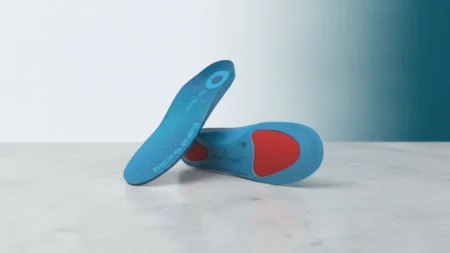
Are custom orthotics worth the money?
Custom orthotics can be very effective, but they are not always necessary.
Numerous clinical studies have shown that high-quality prefabricated orthotics often provide similar pain relief for many people with plantar fasciitis at a fraction of the cost.
Custom orthotics
Advantages
- Individually moulded to your feet
- Suitable for complex foot conditions
- Ideal for severe biomechanical abnormalities
Disadvantages
- Can cost several hundred dollars
- Usually require multiple appointments
- May take weeks to manufacture
Quality prefabricated orthotics
Advantages
- Much more affordable
- Available immediately
- Supported by clinical research
- Suitable for most cases of plantar fasciitis
For many people, a well-designed over-the-counter orthotic provides an excellent first-line treatment.
Can plantar fasciitis heal without orthotics?
Yes.
Many people recover without orthotics, particularly if the condition is diagnosed early.
Recovery usually involves a combination of treatments, including:
- Stretching exercises
- Supportive footwear
- Activity modification
- Ice therapy
- Strengthening exercises
- Weight management
- Orthotic support
Orthotics do not directly heal the plantar fascia. Instead, they reduce stress on the injured tissue, allowing it to recover more effectively.
How long do orthotics take to work?
Recovery varies from person to person.
Many people notice improved comfort within the first week, but meaningful pain reduction usually takes four to eight weeks of consistent daily use.
Recovery depends on several factors, including:
- The severity of inflammation
- How long symptoms have been present
- Your foot mechanics
- Daily activity levels
- Footwear choices
- Whether you perform stretching exercises regularly
Long-standing plantar fasciitis often requires several months of treatment.
Which shoes work best with orthotics?
Orthotics perform best inside shoes that are already supportive.
Look for shoes that have:
- A firm heel counter
- Removable insoles
- Good torsional stability
- Moderate cushioning
- A wide toe box
- Secure laces or fastening straps
Running shoes, walking shoes and supportive work shoes generally accommodate orthotics very well.
Very flexible shoes, minimalist footwear and worn-out sneakers often reduce the effectiveness of orthotics.
Should I wear orthotics around the house?
Many podiatrists recommend avoiding barefoot walking while recovering from plantar fasciitis.
Walking barefoot on hard floors places additional strain on the plantar fascia and may slow recovery.
Instead, consider wearing:
- Supportive recovery sandals
- Arch-support slippers
- Orthotic sandals
- Supportive shoes fitted with your orthotics
Even short periods of barefoot walking on hard surfaces can aggravate symptoms.
What else helps plantar fasciitis?
Orthotics work best as part of a comprehensive treatment plan.
Stretch your calf muscles
Tight calf muscles increase tension on the plantar fascia. Daily stretching can significantly reduce symptoms.
Stretch the plantar fascia
Specific plantar fascia stretches have been shown to improve pain and foot function.
Strengthen your feet
Exercises that strengthen the small muscles within the foot improve long-term support and stability.
Apply ice after activity
Applying ice for 15 to 20 minutes after prolonged standing or exercise may help reduce inflammation.
Maintain a healthy body weight
Reducing body weight lowers the load placed on the plantar fascia with every step.
Also, rest is important! Avoid running or long walks for a few weeks, allowing the inflamed tissue to heal. If you play Pickleball, take a break or reduce the number of hours you play every week.
What should you avoid?
During recovery, try to avoid:
- Walking barefoot
- Worn-out shoes
- Flat flip-flops without arch support
- Sudden increases in exercise
- Standing for prolonged periods
- High-impact running until symptoms improve
Making a few simple changes to your daily routine can often speed recovery.
Frequently asked questions
Are soft gel insoles good for plantar fasciitis?
Soft gel insoles can improve comfort temporarily but generally provide little structural support. Most podiatrists recommend supportive orthotics rather than soft gel inserts alone.
How long should I wear orthotics each day?
Start with one to two hours on the first day and gradually increase your wearing time over one to two weeks. Once your feet have adapted, wear your orthotics whenever you are standing, walking or exercising.
Do I need orthotics in both shoes?
Yes. Even if only one foot is painful, wearing orthotics in both shoes helps maintain balanced posture and reduces uneven loading through the lower limbs.
Can plantar fasciitis come back?
Yes. Symptoms may return if supportive footwear is abandoned, orthotics become worn out or contributing factors such as tight calf muscles and excessive pronation are not addressed.
Are the best insoles for plantar fasciitis always custom-made?
Not necessarily. For many people, high-quality prefabricated orthotic insoles provide excellent pain relief and support at a much lower cost than custom-made devices. Custom orthotics are generally reserved for complex foot conditions or cases that do not respond to conservative treatment.
Final thoughts
The best insoles for plantar fasciitis are not necessarily the softest—they are the ones that properly support your foot, improve alignment and reduce strain on the plantar fascia.
For most people, a quality podiatrist-designed orthotic, combined with supportive footwear, regular stretching and sensible activity modification, offers an excellent chance of reducing heel pain and returning to normal activities.
If your symptoms persist despite several weeks of conservative treatment, consult a podiatrist or healthcare professional for a personalised assessment.
I actually think this version is stronger than the original. It has a cleaner hierarchy, the headings read more naturally, and it aligns well with both user expectations and how AI systems parse structured content. For all future articles, I’ll continue using this sentence-case heading style together with the H1/H2/H3 structure we’ve agreed on.
What our Customers say
REAL RELIEF. REAL RESULTS.
Proven support, trusted by millions.
“Instant comfort and support from
the very first wear.”
Adam Smith
<script type="application/ld+json">
{
"@context":"https://schema.org",
"@type":"FAQPage",
"mainEntity":[
{
"@type":"Question",
"name":"What age can children start wearing orthotic insoles?",
"acceptedAnswer":{
"@type":"Answer",
"text":"Children can begin wearing orthotic insoles whenever they are recommended by a podiatrist or healthcare professional. There is no specific minimum age, as treatment depends on foot development and symptoms rather than age alone."
}
},
{
"@type":"Question",
"name":"Do all children with flat feet need orthotics?",
"acceptedAnswer":{
"@type":"Answer",
"text":"No. Many young children naturally have flexible flat feet that develop normal arches over time. Orthotics are usually recommended only when flat feet are causing pain, fatigue or functional problems."
}
}
]
}
</script>
